IRSF GRB Observation
Last Update : 2009/10/08
Scientific targets
Our scientific targets is serching for the highest redshift burst by collaborationg with IRSF.
Since the launch of the Swift satellite, 100 of GRBs are detected every year and wide follow-up by ground-based telescopes is conducted. Because of the unique geographical location of South Africa, IRSF and NZ, MOA can have many chances of the "first ground observation" for a certain fraction of GRBs. To learn the GRB and its environment, fast, dense and continuous follow-up is important.
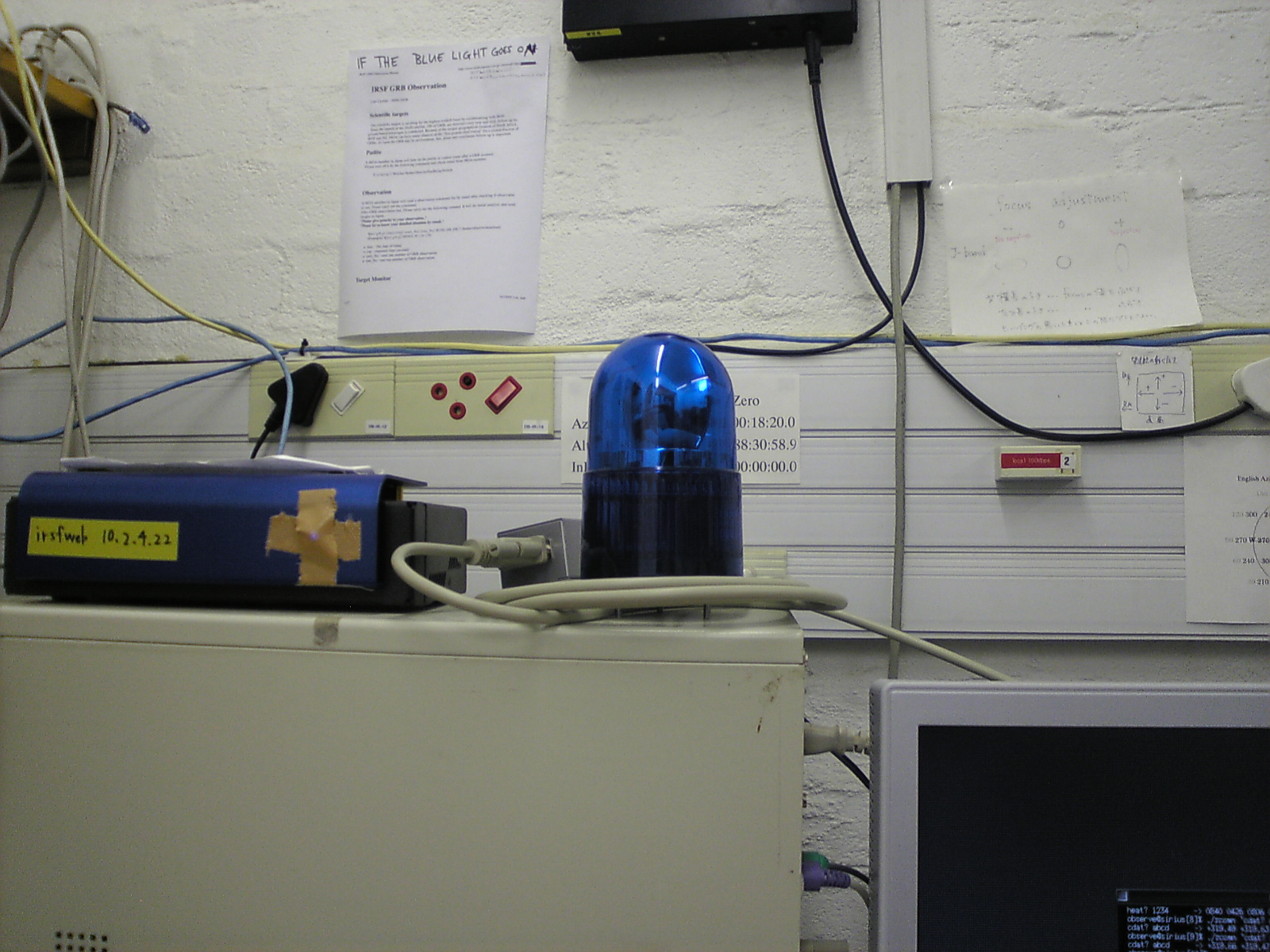
Beacon Light
A MOA member in Japan will turn on the beacon light in control room after a GRB occured.
Please turn off it by the following command and check email from MOA member.
- $./testprog 0 @sirius:/home/observe/bin/RelaySwitch
Observation
A MOA member in Japan will send a observation command file by email after checking if observable or not. Please carry out the command.
After GRB observation end, Please carry out the following comand. It will do initial analysis and send images to Japan.
If something error happened, try again after erasing the file "ASTRO-IRAF-CL.LOCK" in "/home/observe".
"Please give priority to your observation."
"Please let us know your detailed situation by email."
- $perl grb.pl (date) (exp) (start_No) (end_No) @192.168.100.7:/home/observe/moa/tool/
- [Example] $perl grb.pl 090904 30 130 139
- date : The date of today
- exp : exposure time (second)
- start_No : start run number of GRB observation
- end_No : end run number of GRB observation
Target Monitor
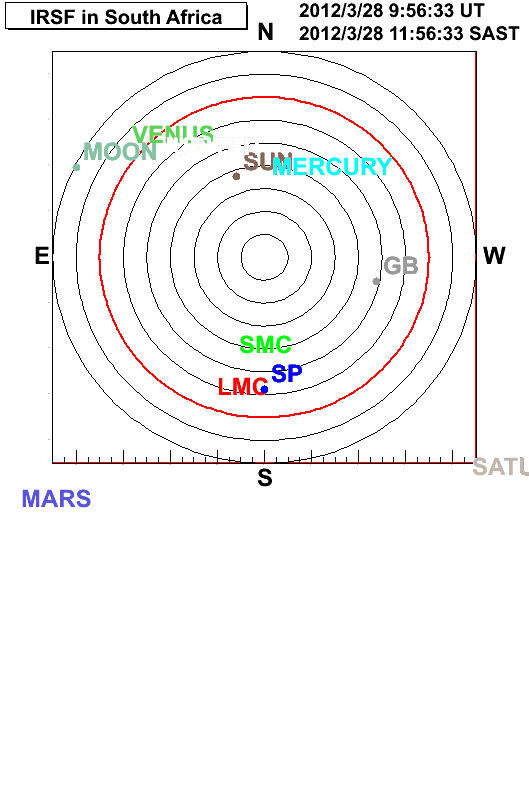
Following is the target monitor. You can check the GRB information by it.
After GRBs occur, the GRB plots will appear in it.
Each black circle indecates altitude of 0, 10, 30, 40, 50, 60, 70 and 80 degrees, and red circle is 20 degrees.
It is updated every about one minute. The newest target monitor will not load unless you click the reload button.